At the 2026 Boutique Hotel Owners Conference, Matt and Mike French of Life & Times explained how a 20-room motel on a former Western movie set gr...
BLLA Editorial Team
November 5, 2026 – 10 min read
At the 2026 Boutique Hotel Owners Conference, Matt and Mike French of Life & Times explained how a 20-room motel on a former Western movie set grew into a restaurant group, a revived town newspaper, and a community built to last.
Matt and Mike French first drove up to Pioneertown for a concert. “It was one of those magical summer nights,” Matt recalled. “There were people playing guitar in the street and wandering around, and we were kind of like, ‘What is this place?'”
More than a decade later, the brothers own a good part of the answer. Through their company, Life & Times, they restored the town’s original motel, reopened its saloon, revived its newspaper, and have shaped much of the life around them. Along the way they did something few hoteliers do: they moved in.
In conversation with BLLA’s Ariela Kiradjian at this year’s Boutique Hotel Owners Conference, the brothers explained what changes when an owner becomes a neighbor, and how a hotel can grow into a whole world without losing what made the place worth visiting in the first place.
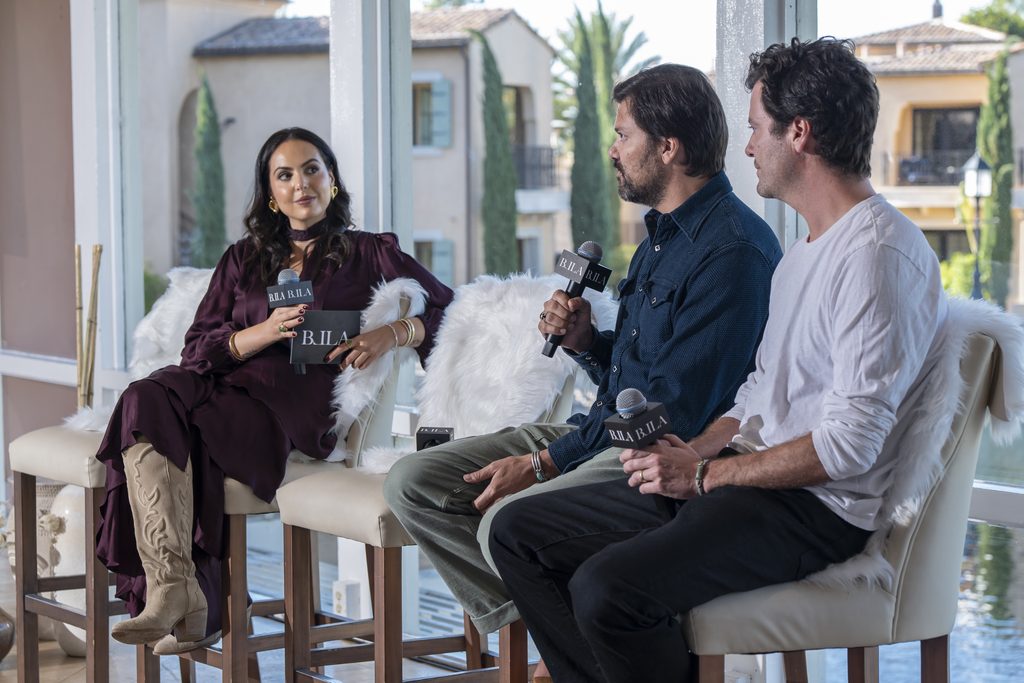
From left to right: Ariela Kiradjian, Partner & COO, BLLA, Matt and Mike French of Life & Times
A movie set that became a home
Pioneertown sits just outside Joshua Tree National Park, in the High Desert above Palm Springs. It was built in 1946 as a working Western movie set. “Instead of just building facades, they actually built buildings,” Matt explained. “It was kind of a living, working movie set.” There was a motel where the actors stayed, a couple of saloons, and a main street. Next door sits Pappy & Harriet’s, once an understated biker bar and now one of the most celebrated live music venues on the West Coast, the kind of room where Paul McCartney has played a surprise show.
The brothers bought the Pioneertown Motel in 2014: 20 rooms built of railroad ties, with, as Matt put it, “tons of character.” It was not their first venture together. Mike reminded the room, to his brother’s mild dismay, of an earlier attempt at a linen shirt company. “That didn’t really pan out,” he said.
The motel did. Matt was living in Portland and Mike in New York when the two decided to spend some time in the desert and see what else was possible. They expected a short stay. Instead, friends started visiting, the press took notice, and by 2018 the desert was home. Mike admitted he had been “very hesitant” about the move.
Living there changed the business. “Once we were living there, our return profile totally changed,” Mike said. “We need to create things that actually are things we want to experience and enjoy.”
Building for the people who live there
In 2018, Life & Times took over the Red Dog Saloon, the original saloon in Pioneertown. That, Mike said, was when the brothers were fully committed. The Copper Room in Yucca Valley followed. The restaurants shifted the company’s relationship with the area in a way the motel alone could not. “With rooms only, it was just tourists,” Mike said. “But with the restaurants, we really struck a different cultural chord.”
The demand is real. One attendee told the room she had tried to have brunch at the Red Dog after a recent visit, only to find it so busy the kitchen had to pause service.
A newspaper that promotes the competition
The brothers’ most unusual move was reviving the Pioneertown Gazette, the town’s original paper, first published in 1947. When they arrived, Mike said, the local business scene was “very tribal, very competitive.” The Gazette was their answer. “We just started promoting our competitors and promoting everyone else’s events and businesses and small businesses,” he said. The logic was simple: a rising tide lifts all boats.
The Gazette has since grown into editorial, with a website covering the wider High Desert. It has also become a strategic asset in a way few would have predicted. Mike said the publication now serves as a third-party source for AI tools: “We’re getting cited in most chat conversations for anything that’s happening in the High Desert.” For a hotel group, that means a trusted, independent voice on the region, one the brothers built themselves.
Community work extends further, through philanthropy, a yearly bocce tournament, and co-programming with Pappy & Harriet’s. The thread running through all of it is the same: build the place you would want to live in, and the visitors will follow.
Amplify what’s already there
Mike oversees much of the mood across the properties, down to the music. He also moonlights as a house music DJ at the Red Dog on weekends. Kiradjian asked how much of a guest’s experience comes from things they would never think to mention in a review.
His answer was to lean into the conditions of the place rather than fight them. “People are not on their phones. There’s no service. You’re seeing the stars. You’re walking on dirt roads. There’s no streetlights,” he said. “There’s kind of serendipity that happens in that, and our job is to amplify that.”
The role of the operator, in this view, is to set a stage. At the Red Dog and the Copper Room, guests linger over dinner and drinks, and Mike noted that people largely stay off their phones. The remoteness that might look like a disadvantage on paper becomes the experience itself.
Traditions over one-offs
Collaboration is central to how Life & Times operates, from art fixtures and branding in the motel renovation to the events that fill the calendar. “We collaborate as much as possible,” Matt said. “It’s really core to how we operate.” Local artists come first.
The clearest example is the High Desert Art Fair, held each March. The team empties the motel rooms of furniture, and a different gallery takes over each one. Hundreds of visitors move room to room buying art, with music and food over the weekend. Matt described the most recent edition as a breakout year, with significant press, and said the next will be bigger.
Brand partners follow the same logic. For several years running, the apparel brand Aether has bought out the property for the Aether Rally, bringing a fleet of adventure vehicles and motorcycles for a rally through the desert, with events at the Red Dog and the motel.
The brothers are selective about which events they take on. “We kind of at the beginning really set out to create traditions,” Mike said. “If someone wants to do an event or a buyout, we’re much more inclined if it’s going to be something that will be annual and we can grow together with the producer.” A recurring event builds a relationship, an audience, and a reason to return. A one-off rarely does.
Matt and Mike French of Life & Times on why building a destination starts with becoming part of the community.
Trusted partners and a working division of labor
Asked how they split the work, the brothers said a great deal overlaps. Matt leans toward finance and development. Mike handles marketing, branding, promotion, and concept. “We have tried every which way to divvy things up, and mostly failed,” Mike said. With five or six projects now underway, they have settled on a simpler system: each brother takes full lead on his own projects. “Each of us kind of intuitively knows when to come to the other for things,” he said. “That’s probably a brother thing.”
Operators who know restaurants
The restaurants are run in partnership with Last Word Hospitality, the group behind Found Oyster. The relationship began with a phone call. Mike asked a friend in the restaurant business whether he knew anyone who could open “this decrepit saloon in Pioneertown.” One introduction led to another, and the operators made the drive out. “They came out to Pioneertown, and they’re like, ‘We’re in,'” Mike said. “We’ve been partners with them since that day.”
That trust is what lets the brothers keep building. “We’ve been pretty intentional with keeping management trusted with our partners, so we’re not involved in the day-to-day at the restaurants,” Mike said. “That’s obviously a huge load off our plate, to have that trust and that relationship, so we’re able to focus on new projects.”
An audience member put the point simply: running properties from the desert to the Pacific Northwest works only because the brothers have entrusted the right people.
Taking the model elsewhere
After the motel, the brothers went looking for a similar situation and found it on Whidbey Island, about two hours from downtown Seattle. Captain Whidbey is a lodge more than a century old, set on several waterfront acres with guest rooms, cabins, a dock, and a restaurant. “Just totally idyllic and just beautiful,” Matt said. “It really hadn’t been renovated or touched, kind of like Pioneertown.”
They had no prior connection to the island. “We kind of went up there to kick tires,” Matt said. The property followed the same model as Pioneertown: restore something with history, respect its character, and build around it. It opened, as Mike noted, just days before the pandemic.
What comes next
The pipeline is full:
Pioneertown Motel expansion. After six years in the entitlement process, the brothers received approval to add rooms, a restaurant, a spa, a pool, an extension of Main Street, and new retail.
Desert Hot Springs. A master-planned wellness destination on geothermal land, beginning with a bathhouse built around the natural hot water, with sauna and steam.
Yucca Valley. The reopening of a wedding venue in an old church.
Lord Fletcher Inn. A 1966 steakhouse in Rancho Mirage that was Frank Sinatra’s favorite. The brothers came to know the Sinatra family through the Copper Room, where his granddaughter performs. The family has blessed the branding and contributed personal photographs and artwork.
Capital from the community
An audience question turned to financing. For the restaurants, the brothers raised money through community notes, small investments sold largely to locals. “We decided to create notes in an effort to get the local community to have a sense of ownership in the restaurants, and that worked out really well,” Mike said. Hundreds of people invested in the Red Dog: the people building things in the desert, who would support the bar and show up. “It’s really kind of paid dividends in that way,” he said. They repeated the model at the Copper Room.
The next projects are a different scale. The motel expansion and the Desert Hot Springs project will be too large to self-finance, and the brothers said they will need new structures and outside capital. “That’s why we’re here,” Mike joked.
For owners
Become part of the place. The brothers’ business changed once they lived there. Build what you would want as a resident, and guests will feel the difference.
Give locals a reason to come. Rooms bring tourists. Restaurants, bars, and events bring neighbors, and neighbors give a place its life.
Promote the ecosystem. Lifting other local businesses makes the whole destination stronger, and an independent local voice can become a source that AI tools trust and cite.
Amplify what’s already there. No cell signal, dark skies, and dirt roads can become the experience. Set the stage rather than fight the setting.
Choose traditions over one-offs. Favor events and buyouts that can recur and grow with the producer.
Partner with specialists. Trusted operators, especially in food and beverage, free owners to focus on vision and growth.
Divide the work clearly. Give each partner full ownership of specific projects, with an easy path to ask for help.
Let the community invest. Small community notes can build both capital and loyalty, though larger projects will need different structures.