What three cultural operators taught a room full of investors about the only asset that actually earns loyalty. From the Boutique Hotel Investment ...
BLLA Editorial Team
June 24, 2026 – 7 min read
What three cultural operators taught a room full of investors about the only asset that actually earns loyalty.
From the Boutique Hotel Investment Conference, June 3, 2026 — Cultural Capital: The Currency You Can’t Buy
Pierre Bourdieu argued that society runs on more than money. It runs on taste, knowledge, and the kind of fluency that signals belonging without saying a word. At BLLA‘s Boutique Hotel Investment Conference, held at 237 Park Avenue, that argument walked into a room full of investors and spent thirty minutes making itself very difficult to ignore.
The panel brought together Hailey Brooks, Co-Founder and Creative Director of Moss, a private members club that opened in Midtown Manhattan last November, and Damien del Rio, Principal Owner of Sauced, a wine bar with locations in Williamsburg, Manhattan, Nashville, and Austin. Also present: Ross Michaels, Co-President of Park Avenue Artists, who built a hidden recording studio in the basement of the Walker Hotel in Greenwich Village and has spent the last few years watching it become something he never quite planned for. Spenser Apramian, VP of Investments at Bridgeton, moderated.
None of them came from the same world. But they kept saying the same thing.
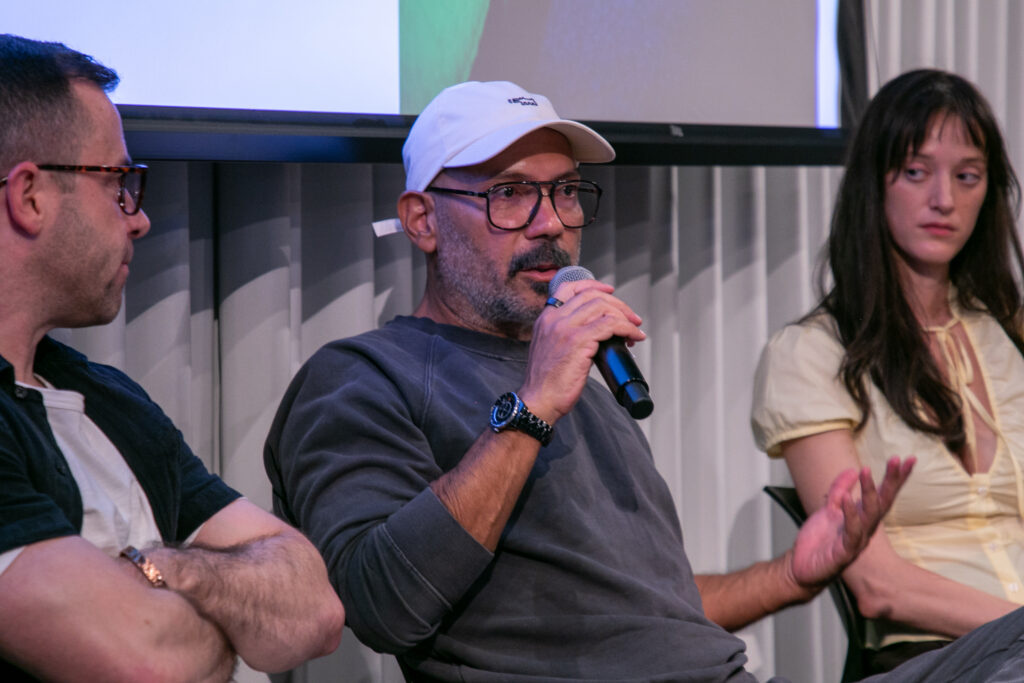
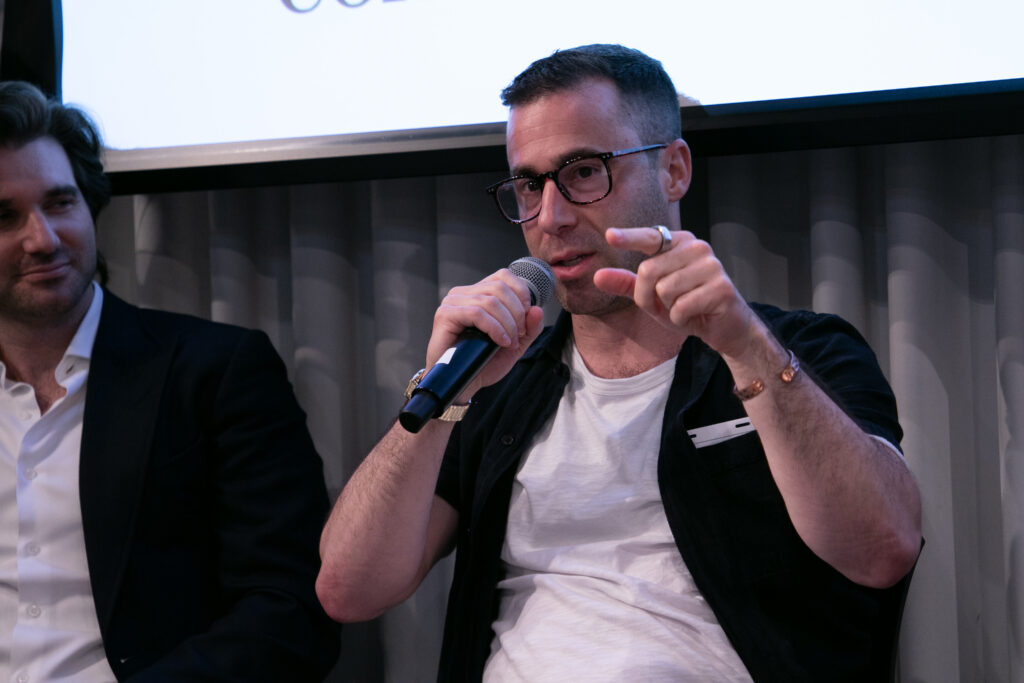
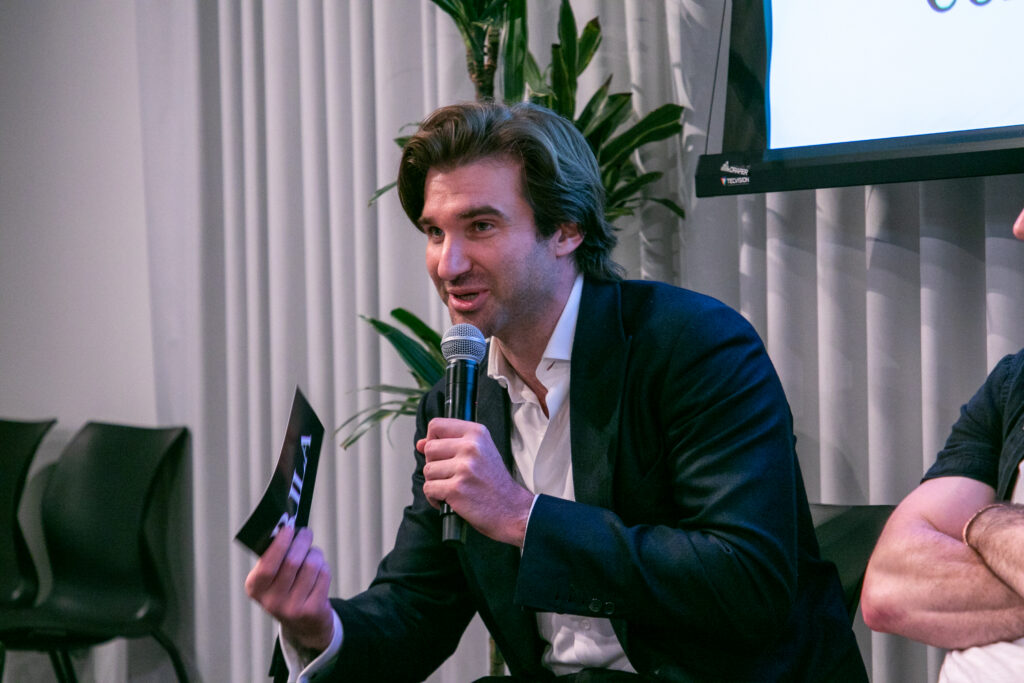
The panel, left to right: Spenser Apramian of Bridgeton, Hailey Brooks of Moss, Damien del Rio of Sauced, and Ross Michaels of Park Avenue Artists.
Culture Is Seeded, Not Installed
When Apramian asked del Rio how he thinks about cultural capital in the context of hotel partnerships, del Rio didn’t talk about programming or activations. He talked about values.
“Culture comes back to what are your values as far as what you’re creating,” he said, “and then you’re seeding that environment through those values — internally and externally.”
For Sauced, that shapes who del Rio even considers working with. The hotels on his list — Standard New York, Hotel Amour in Paris — got there because they read right, not because they reached out. “Hotel Amour in Paris, they’re cool as hell,” he said. “André Saravia is one of the best designers, cultural icons, from the 90s through even today. He’s culturally relevant.” That partnership led to a Fashion Week event where Daft Punk showed up and Purple magazine was involved. Del Rio is clear that nobody planned that outcome. “That’s how magic happens,” he said. “You both are speaking the same language.”
For investors in the room wondering how to be better partners for operators like him, del Rio’s answer was almost a shrug. The partnership either makes sense from the start or it doesn’t. “It goes back to the partnership from the start. Does it make sense? If it doesn’t, it doesn’t. If it does, it does.” He’s turned down deals. He’ll turn down more. That’s the point.
Damien del Rio, Principal Owner of Sauced
Recurring Revenue and the Member Who Actually Comes Back
Hailey Brooks is running a different kind of operation — one where culture has to survive contact with a membership model and a P&L.
Moss sits at the base of an 88-story tower on 43rd and Fifth. Two restaurants, two bars, a bathhouse with a hammam and sauna and pool, a pickleball court, golf simulators, a Pilates studio. When Brooks talks about what makes someone choose Moss over the other six members clubs that have opened in New York in the last few years, she doesn’t start with any of that. She starts with the programming — what Moss calls “intelligent leisure” — and specifically the kind of member it takes time to find.
“The people who really contribute to the culture of the space, they take a little bit longer to sell,” she said. “The people who are bringing their community through — that’s eventually where we want to get with our member acquisition.”
She tracks culture the way you’d expect: daily use rates, weekly use rates, which parts of the club members are actually using versus what they signed up for and never touched. “If they are signed up for all access and they’re never coming to the gym — that’s something we like to take a look at.” Moss opened in November. They’re still meeting with people who have no connection to the community because the community is still being built. But the end state Brooks is working toward is a club that only grows through referral. “Eventually, that’s where we want the product to speak to people,” she said.
Ross Michaels, Co-President of Park Avenue Artists
The Anti-AI Argument
When Apramian brought up artificial intelligence, Ross Michaels didn’t hesitate.
“Our collaboration at the studio is the anti-AI. The thing you can’t replace with AI is a physical experience — you’re going, you’re seeing, you’re smelling.”
The studio he’s talking about is accessed through a fake door in the basement of the Walker. You spray a bottle, a closet opens into the space. It’s hosted Joshua Bell, Jon Bon Jovi, ASAP Berg. It has a pair of $120,000 Genelec speakers — one of maybe twenty pairs in existence. Michaels described what the room actually does with a story about Sid Sriram, a massive artist in India who was trying to build something in the US. Sriram ran a raffle for his fifteen most loyal fans and charged them $4,000 each to sit in a room and listen to his unreleased record. “Each one of them came out saying, ‘I could have given more money. That was the best experience of my life.'”
“Anything I can do to anti-AI is probably going to succeed in some sense,” Michaels said.
Del Rio and Brooks both use AI and said so plainly. “It frees me up to be more creative,” del Rio said. “It streamlines things that I would have taken hours to do.” Brooks is more conflicted about it — she described herself as less AI-literate than her sister, who is president of Moss, and acknowledged that creative departments that resist the tools will find themselves getting smaller. But she named the thing Silicon Valley is still working on: “Taste is their new meter. How they can create that — I’m not sure.” The question she’s sitting with is how to let her team use the tools without losing the thing that makes the team worth having.
Spenser Apramian, VP of Investments at Bridgeton
What This Means for Boutique Hotels
The Walker Hotel studio makes no money. Michaels said it without embarrassment. “The lack of transaction is kind of what makes more transactions happen.” Deals with Whitney Houston’s estate and Miles Davis were done in that room — because people were in the room, comfortable, being taken care of, not being sold to. Apramian put it simply: “We don’t market it at all, we don’t sell it as event space, it’s Ross’s space.” He added: “Investors frankly love going in that space.”
When Jon Bon Jovi came through, he spent $7,000 at the hotel restaurant in two hours. That’s the math, though nobody leads with it.
What the panel kept circling back to is something boutique hotel operators tend to understand better than most: the properties building real cultural depth are usually giving something up to do it. Control over the space. Certainty about the return. The ability to put the value in a deck before the deal is signed. What comes back is a place people talk about, return to, and bring people to — not because they earned points, but because they felt something. That’s the asset. It doesn’t show up on a pro forma until it does, and then it’s the only number that matters.
BLLA’s Boutique Hotel Investment Conference took place on June 3, 2026, at 237 Park Avenue, with an evening program at NeueHouse Madison Square, made possible with the support of Blank Rome and Convene Hospitality Group.